
The Infinite Mules Problem
AD&D isn't Really A War Game

Talk to any group of people playing RPGs together for more than a few months and they develop a jargon, especially if they have a go-to RPG game. My core group of players has been playing D&D with me as DM for an average of about 20 years. We obviously have damn near our own language with everything from ‘whippoorwill!’ to ‘Grandmother’ causing an immediate emotional reaction. Certain phrases are also very important, such as ‘everything is Skull Mountain’, ‘never trust Rupert’, and ‘the sky shall darken’ being shorthand for much larger ideas.
But the phrase we all agree is most universal is ‘the Infinite Mules Problem’.
The first time the term ‘Infinite Mules’ came up concerned an in-game trip to the super dungeon called Skull Mountain, which at the time was five days travel through a wilderness effectively devoid of food and water, meaning the characters had to bring supplies for the trip to, from, and the duration of delving with them.
At the simplest in my AD&D campaigns a person needs 5 pounds of food and 5 pounds of water every day, horses, ponies, and mules need 10 pounds of each every day. Without magical lights (or as backup) each 8 hours in the dungeon consumes about 15 pounds of light source fuel (oil, torches, whatever). YES, in actual play it is more granular, but these averages work very, very well.
The party (5 PCs and 5 henchmen) wanted to spend 3 days underground and wanted two light sources. They also planned for an ‘extra’ day underground just in case they ran into a trick or something, so they needed 14 days of food and water as well as enough fuel for 96 hours in the dungeon. that’s 700 lbs of food, 700 pounds of water, and 360 pounds of light sources for a total of 1,760 pounds.
The average in-game mule can carry 500 pounds unencumbered so 4 mules would leave excess capacity and they could use the same mules to haul back loot because, of course, more than half the supplies would be used up getting there and exploring. But those 4 mules would themselves need 1,120 pounds of food and water. So not only no excess capacity, but add two more mules! But those two mules add 560 more pounds, and so on until they realized they needed 10 mules to carry the food, water, and light sources with some excess capacity.
That’s when it got fun. They couldn’t just leave 10 mules on the side of a mountain for 3 or 4 days! Someone had to guard, feed, and water them! One of the henchman might stay, but alone? So they hire 9 mercenary spearmen and a sergeant to stand guard outside with one henchman. But those spearmen need, of course, 1,400 pounds of food and water, meaning they need more mules! Toss in spare gear for the mercenaries and we’re up to 5 more mules.
Once they talk to the man selling mules they find out that they need professionals to load, unload, lead, and care for the mules or the mules will not be at full carrying capacity, be more prone to being injured, get aggressive, and so on and figure they’ll hire one pack handler per five mules for 3 more men. More men needing another mule’s worth of food, water, and other supplies, which means….
Finally the 25 men and their 15 mules set off up the mountain.
The adventure was raucous, the loot was amazing, and in a shocking twist all the PCs and NPCs made it some safe, sound, and rich. Game months later the party decided to go back but this time it was 5 PCs, 16 henchmen, and 20 mercenaries, and two cooks. As the players started preparing I mentioned something about the supplies they need when the player jack said,
“Is the Dungeon Master pointing out that we technically need an infinite number of mules? AGAIN?”
I have told a lot of this anecdote before when I was explaining why resource management makes players interact with the game world more. But today I am broaching a different topic - the very nature of AD&D and, arguably, old school games.
I am far from the first to point out this fact, but old school RPGs are resource management games. Indeed, they are much more resource management games than they war war games.
No, I am not saying D&D is never a war game, nor that it isn’t derived from a war game, Neither am I denying the resource management aspects of war games (although they are much lighter than in RPGs).
What I am saying is that an intense focus on D&D as a war game can be just as detrimental to playing, running, and understanding the game as an intense focus on storytelling.
Here’s a concrete example from my Seaward campaign (which turns 46 years old in four months) to illustrate the difference between D&D and a ‘pure’ war game.
57 game years ago the Dead War began when the necromancer Pathin the Dread Lord, called Pathin the Foul, attacked the Kingdom of Seaward. In addition to the 2,000 zombies led by him and his apprentices he was joined by allies such as the Queen of Pirates, the Champion of Slaughter and his cultists, the Plague Cult and its rotting leaders, and a handful of villains. After intense fighting his allies were scattered or dead, most of his apprentices likewise dead, his army destroyed, and he fled. In the 55 years since his last sighting Pathin was at most a rumor.
No more. Various groups of PCs unintentionally disrupted his new allies and plans and he has launched the new Dead War (called Dead War 2: Electric Boogaloo, of course). here is a map of the current state of war (all hexes = 10 miles)
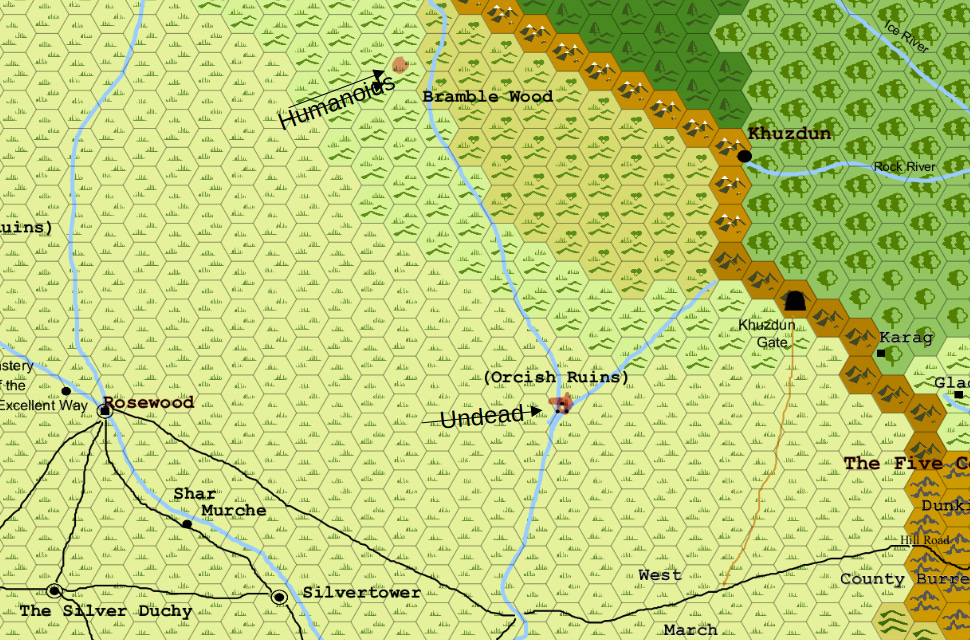
That is a force of thousands of kobolds, goblins, and bugbears in the north and over 4,000 undead (mainly skeletons and zombies) in the south. The humanoids are moving west toward the river, the undead poised to cross the river to the west or east bank.
The anticipated routes of advance are below.
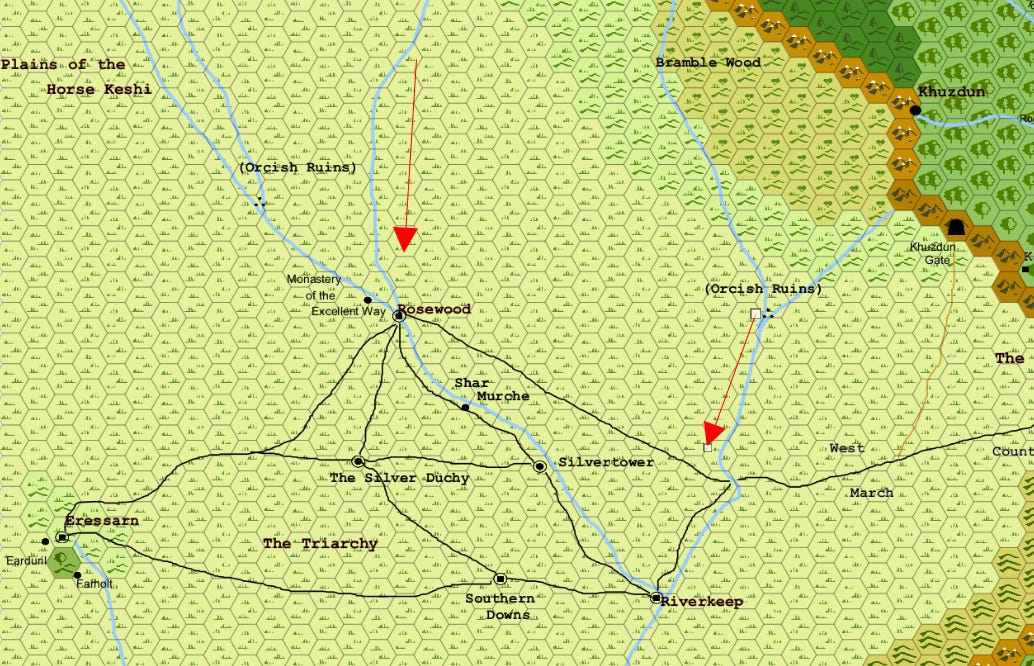
The defenders, the Triarchy, are the domains of three PCs (all mages) as well as the fortresses of allied NPCs. Their total defending armies?
About 450 troops total.
Pretty straightforward war game, right? Just pull out the mass combat rules and have at it!
Not so fast.
This isn’t Chainmail, Battlesystem or just my own mass combat rules - this is AD&D 1e, so resource management is already a key element. The humanoids are following the river not just for a secure flank, but for access to water. They have slaves and such along to carry (and be!) food. They are being told to not use their limited arrows for hunting because they have a finite number and they are for battle. When battle begins? No infinite arrows, nor thrown hand axes as is so common in mass combat systems for the OSR.
Because AD&D is more resource management than war game logistics must impact warfare or you stop playing D&D. As mentioned before, Chainmail and most other war games are pretty much just about the actual battle and largely ignore logistics. Likewise, they also are not suited for the before and between of PCs harassing and sniping the enemy. A mage getting off a Fireball or two into the baggage train of the humanoids is going to cause a lot of trouble.
On the other hand, the undead are a serious problem because they never sleep, eat, or drink. They can march 24/7 and even fight 24/7. Because undead ‘solve’ the Infinite Mules problem they are much, much more dangerous - in D&D. not in a ‘pure’ war game.
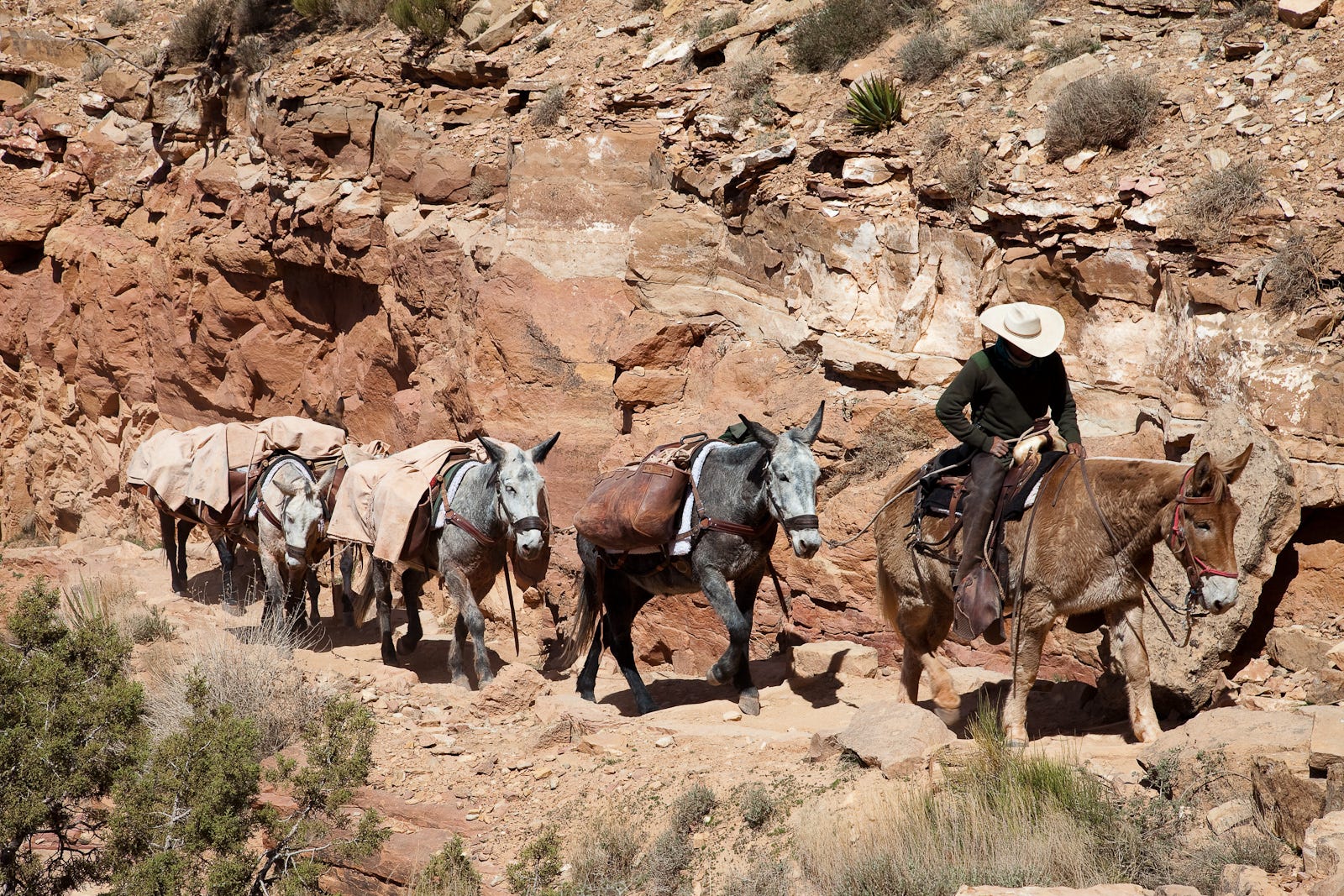
So think about how much weight your PC can carry, how much he needs to carry, and consider buying a mule.
Yes, I’m phone posting
As I was reading, I started thinking of the rocket equation, which gives the mathematics needed to solve this problem in general. There would need to be a discrete version though.
Also, oh to play D&D 1e.